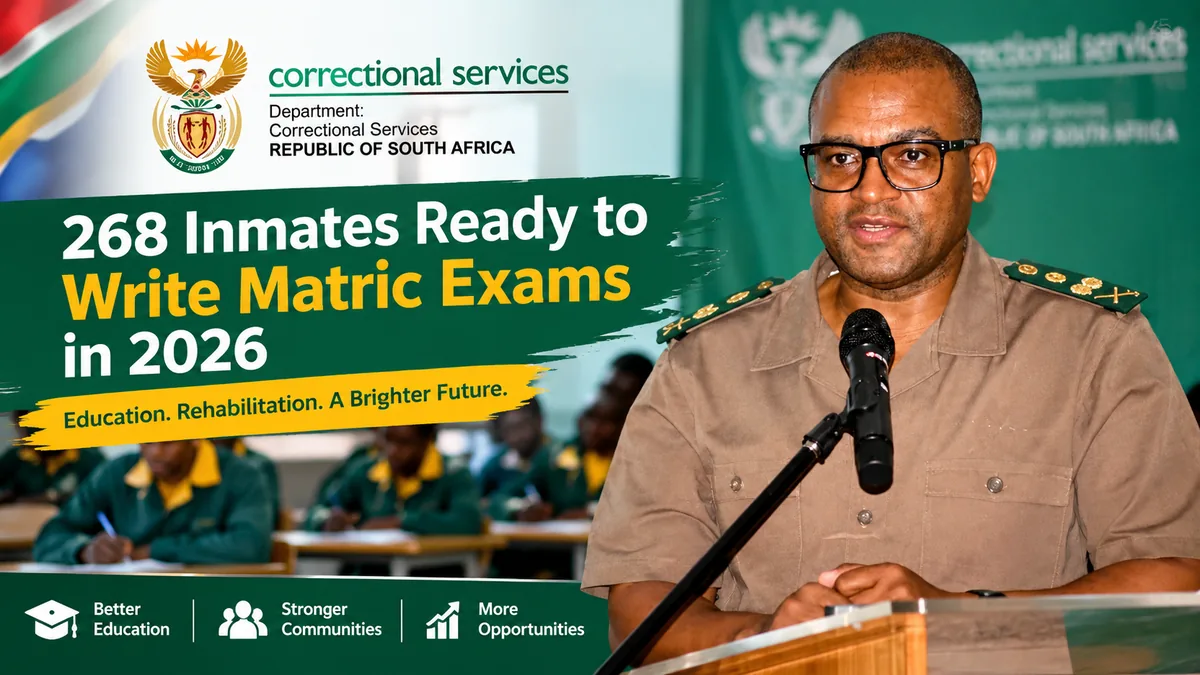
South Africa’s correctional education programme is preparing for an important examination period, with 268 incarcerated learners expected to write their National Senior Certificate (NSC) examinations in 2026. The candidates are enrolled at 18 correctional services schools across the country, according to the Department of Correctional Services (DCS).
The increase is significant. The department’s latest announcement reports a 56.7% rise in the number of inmate matric candidates compared with the 171 candidates cited for 2025 in that announcement. It also follows a strong examination performance in the previous year, when correctional services schools recorded an overall pass rate of 94.4%.
Beyond the numbers, this development highlights an important question: what can access to education mean for people serving sentences, their families and communities, and their prospects after release?
For learners preparing to write matric behind bars, the examinations represent an opportunity to complete a recognised school qualification and potentially pursue further education or employment when circumstances allow.
Overview: 2026 inmate matric examinations
Here are the key details reported by SAnews and the Department of Correctional Services:
- Number of candidates: 268 inmates
- Examination: National Senior Certificate (NSC)
- Schools involved: 18 correctional services schools nationwide
- Previous-year pass rate: 94.4% in 2025
- Reported increase in candidates: 56.7% compared with the 171 candidates cited for 2025 in the readiness announcement
- Expected results announcement: January 2027
- Responsible department: Department of Correctional Services
The department says arrangements are in place to support candidates throughout the examination period. National Commissioner Makgothi Samuel Thobakgale has encouraged learners to remain disciplined, trust the preparation they have completed and give their best during the examinations.
Why are 268 inmates preparing for matric in 2026?
Education is part of the Department of Correctional Services’ rehabilitation and personal-development approach. Instead of treating imprisonment only as a period of confinement, correctional education provides learners with an opportunity to develop knowledge and work towards recognised qualifications.
The 2026 announcement reflects an increase in participation in formal education among incarcerated learners. A larger examination group can indicate that more people are reaching Grade 12 and preparing to complete the NSC while in correctional facilities.
However, the increase in candidates should not automatically be interpreted as proof that every aspect of prison education has improved. Candidate numbers alone do not reveal how many learners enrolled, how many dropped out, how resources are distributed or how individual schools performed.
Those details would be needed for a fuller assessment of the programme’s progress.
Comparing inmate matric candidates from 2024 to 2026
The figures reported over recent years provide useful context for understanding the current examination group.
| Examination year | Reported candidates | Relevant information |
|---|---|---|
| 2024 | 173 | DCS reported that candidates had completed their academic preparation and received support from educators. |
| 2025 | 171 in the 2026 readiness announcement | The 2026 report uses this figure as the basis for calculating the increase. |
| 2025 results | 180 candidates | The January 2026 results announcement separately reported 180 learners writing the NSC. |
| 2026 | 268 | Candidates are enrolled at 18 correctional services schools nationwide. |
Important data note: The published reports contain different figures for the 2025 examination group: the October 2026 readiness report compares 268 candidates with 171 in 2025, while the January 2026 results announcement reports 180 candidates who sat the examinations. These figures should not be combined as if they were identical. The department would need to clarify the difference before a definitive year-on-year series could be established.
Using the comparison stated in the October 2026 announcement, the number of candidates has increased by 97, from 171 to 268. This is equivalent to approximately 56.7%.
The increase is encouraging in terms of examination participation, but the final results will be needed to assess the academic outcomes of the 2026 group.
What did correctional services schools achieve in 2025?
The 2025 NSC results provide an important benchmark for the current candidates.
According to the Department of Correctional Services‘ January 2026 results announcement, correctional services schools achieved an overall pass rate of 94.4%. The 180 learners reported in that announcement came from 18 schools, and 15 schools recorded a 100% pass rate.
The schools also produced 132 distinctions.
KwaZulu-Natal recorded the highest number of candidates, with 50 learners. Of these, 45 achieved bachelor’s passes. The department also highlighted Usethubeni in Durban-Westville and Baviaanspoort in Gauteng for maintaining 100% pass rates over ten years.
These outcomes demonstrate that some correctional education schools have sustained strong academic performance. They do not, however, guarantee that the 2026 group will achieve the same pass rate.
The next results announcement, expected in January 2027, will provide a clearer picture of how the current candidates performed.
How has government supported prison education?
Government’s approach includes formal schooling, educator support and rehabilitation activities intended to help incarcerated people develop skills and prepare for life beyond correctional facilities.
The 2024 examination readiness announcement described several practical measures: educators worked to complete the academic syllabus, candidates underwent assessments during the year, and textbooks and stationery were delivered to schools. The department also reported the introduction of the Intelsat Telematics System at Johannesburg Correctional Centre in 2024 to provide learners and educators with access to study materials.
These examples show how educational support can involve more than registering learners for examinations. Teaching resources, time for revision, assessment and access to learning materials can all contribute to preparation.
The 2026 announcement also acknowledges the work of teachers, school principals and correctional officials. Their roles matter because learners need structured instruction, guidance and a suitable environment in which to prepare.
Nevertheless, the available announcements do not establish that every correctional school has received identical resources or that all earlier challenges have been resolved. A complete assessment of government progress would require information about funding, staffing, facilities, learning materials and results across individual schools.
Benefits of matric education for inmates
1. Better access to further education
A National Senior Certificate can help a learner meet the academic entry requirements for certain college courses, training programmes or other educational opportunities. Admission requirements vary, and some programmes also require particular subjects or marks.
2. Improved employment prospects
Completing matric can help applicants meet the educational requirements for some jobs. It does not guarantee employment, especially where employers also consider experience, additional qualifications, references and other selection criteria.
3. Personal development and confidence
Working towards a major qualification requires commitment, organisation and persistence. Completing the process can provide a meaningful educational achievement for someone seeking to rebuild their future.
4. Support for rehabilitation and reintegration
Education can contribute to rehabilitation by giving learners constructive goals and skills they may use after release. Successful reintegration also depends on factors such as access to work, family support, accommodation and continued training.
5. Potential benefits for families and communities
When people leave correctional facilities with stronger educational foundations, they may be better positioned to pursue further training and participate in their communities. These benefits depend on opportunities being available and on wider barriers to reintegration being addressed.
What happens after the 2026 examinations?
Once candidates complete their examinations, their performance will be assessed through the established NSC results process. The Department of Correctional Services has indicated that the 2026 results are expected to be announced in January 2027.
Candidates who pass will need to check their results and understand which further-study or training options are available to them. Those who do not achieve the results they hoped for may need guidance on supplementary examination opportunities or other recognised education pathways, subject to the applicable rules.
For now, the immediate priority is to complete the examinations under the required conditions and ensure that candidates receive the support they need.
Frequently asked questions
How many inmates will write matric in 2026?
The Department of Correctional Services has reported 268 Grade 12 candidates enrolled at 18 correctional services schools nationwide.
How does this compare with 2025?
The October 2026 readiness announcement reports a 56.7% increase from 171 candidates in 2025. A separate January 2026 results announcement reports 180 candidates, so the difference in published figures requires clarification.
What was the correctional services matric pass rate in 2025?
The department reported an overall NSC pass rate of 94.4% for 2025.
When will the 2026 results be announced?
The department expects the results to be announced in January 2027.
Why is education important in correctional facilities?
Education can help incarcerated learners obtain recognised qualifications, pursue further training and improve their prospects of reintegration after release.
The 268 inmates preparing for the 2026 matric examinations represent a notable development in South Africa’s correctional education programme. The increase in candidate numbers, together with the 94.4% pass rate recorded in 2025, provides encouraging evidence of participation and academic achievement within correctional services schools.
The next important measure will be the 2026 results. These will help show whether the larger examination group has translated into sustained academic success.
Ultimately, access to education in correctional facilities is about more than passing an examination. It is also about creating opportunities for learning, personal development and a more constructive future after imprisonment.

About the Author
Karabo Ntswaki
Karabo Ntswaki is the author and publisher behind CareersPath.org and CareersFocus. Through these platforms, Karabo shares information about job opportunities, learnerships, internships, bursaries and career development in South Africa.
The aim is to help students, graduates and job seekers access reliable information, understand application requirements and explore opportunities that can support their career journeys.